
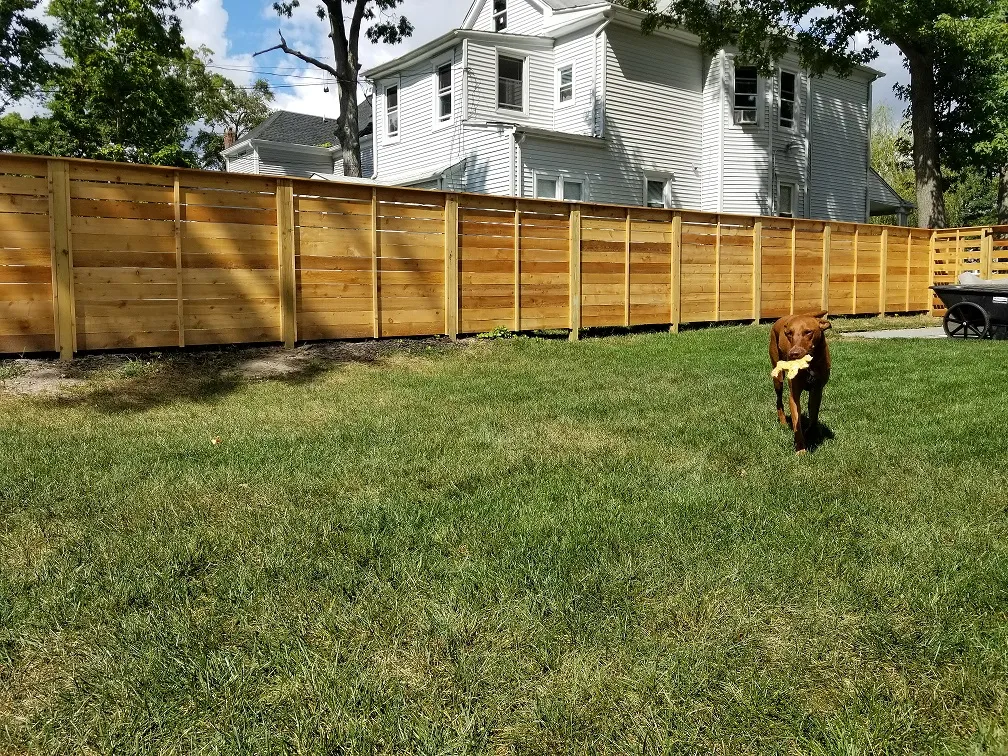
What’s the Best Fence for Dogs?
Ask five fence companies for the best fence for dogs and you will get five different answers. That is because the honest answer comes down to your dog’s size and temperament. A 15-pound terrier and an 80-pound retriever with a habit of testing fences need two different plans. So does a quiet dog who naps in the sun, compared to one who treats every passing squirrel like a passing insult. Get the size and temperament right first. The material choice gets easier after that.
The Best Fence Materials for Dogs
A split rail fence with wire is the recommendation we make most often. Partly because it is budget-friendly, at a point when a lot of dog owners have just taken on a new expense. Vinyl fence for dogs and aluminum fence for dogs are both solid options too. Which one makes sense usually comes down to size.
For most dogs, any of these three will do the job well. The differences show up at the edges. A bigger dog. A determined digger. A dog that leans its full weight against the fence out of boredom. A wood fence for dogs is worth a look here too, especially given the sound-dampening advantage we will get into below. A chain link fence for dogs is another option a lot of owners land on for a bigger or more persistent dog. It can be built taller and to a heavier gauge than a standard split rail setup.
How Tall Does It Need to Be?
Fence height for dogs depends more on the dog than on any general rule.
Four feet is the standard height. It works for most dogs, but some larger or more athletic dogs can clear it without much effort. It is not a fix for every yard.
Five feet is a happy medium. It gives you more security than a four-foot fence, without walling off the whole yard behind a full privacy fence.
For larger dogs, or any dog that might scare a neighbor or a passing kid if it got loose, we usually recommend going to six feet. At that height, a determined dog is not getting through or over.
The best fence for large dogs usually means going taller and choosing a sturdier material. The best fence for small dogs is more about spacing than height. A four-foot fence with wide gaps does not do much for a dog that can slip through them.
A Detail Worth Getting Right
One detail worth getting right: the wire on a split rail fence belongs on the inside of the rails. Mount it on the outside, and a dog pushing against it can pop it loose. It’s a small detail. It’s also the difference between a fence that holds and one you are re-stapling every few months.
If Your Dog Barks or Howls
Material matters here too. Vinyl fencing works almost like an echo chamber for sound, especially in a smaller yard. A dog with a habit of barking or howling can end up louder once the fence goes up. Wood absorbs sound better, making it the stronger pick when noise matters as much as containment. The American Kennel Club lists wood as one of the few fencing materials that also functions as a sound barrier.
How Long Does Installation Take?
Split rail and chain link are usually the fastest fences to install. Often a single day, for a standard residential yard. That matters if you want your dog using the yard sooner rather than later. Larger properties, or setups that need more reinforcement for a bigger dog, can take longer. We will give you a realistic timeline once we have seen the yard.
The Real Differentiator Isn’t the Fence
Every material on this list comes in a range of quality. The fence itself is often not what separate a good installation from a bad one. It’s the company installing it. The parts they use. Whether they’ll tell you the truth about where those parts come from.
In the meantime, ask us directly. We will tell you.